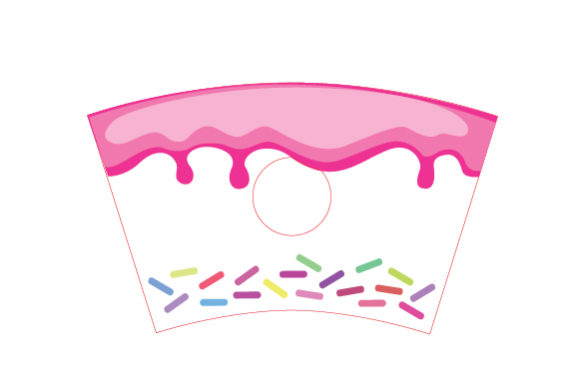
24oz Doughnut Tumbler Wrap
A Sweet, Compact Statement—Not Just for Tumblers
First impression? This isn’t a fussy, over-rendered doughnut—it’s friendly, bold, and built for impact. The 24oz Doughnut Tumbler Wrap has that cheerful, slightly playful weight you’d want on a custom embroidered tote bag for a bakery pop-up or stitched onto a cotton apron for a small-batch coffee shop owner. It’s not overly detailed: no intricate sprinkles or glossy glaze effects that would vanish in satin stitch. Instead, it leans into clean outlines, balanced negative space, and a shape that reads instantly—even at 3 inches wide. That matters when you’re stitching on curved surfaces like caps or tapered mugs, or when your customer is scanning an Etsy listing on mobile.
Where It Shines (and Where It Needs Thought)
I tested the 24oz Doughnut Tumbler Wrap as part of a holiday gift set: embroidered on organic cotton tea towels, then heat-pressed onto a batch of unbleached canvas totes. On both, it held up beautifully—especially with medium-weight cutaway stabilizer underneath. The design’s moderate stitch density kept things breathable on lightweight fabric, and the outer contour stayed crisp without puckering. As a machine embroidery design, it behaves like a confident mid-tier asset: not so sparse it feels cheap, not so dense it overwhelms delicate baby embroidery on onesies or nursery pillows.
It works especially well for sweatshirt embroidery where texture matters—the doughnut’s rounded form softens the rigidity of heavy fill stitch, and its compact footprint fits neatly on left-chest placements. I also used it as an applique design on denim jackets, layering felt under the outline and letting the satin stitch define the rim. No fraying, no distortion. That said, avoid pushing it onto stretchy knits without proper tear-away + cutaway combo stabilizer—and skip it entirely for ultra-thin fabrics like silk charmeuse unless you’re doing a minimalist running stitch version (which this file doesn’t provide).
Real-World Fit: From Craft Fair Booth to Digital Shelf
Last month, I helped a local maker prep for a holiday craft fair. She sells handmade ceramic mugs and wanted coordinated embroidered kitchen towels. We dropped the 24oz Doughnut Tumbler Wrap into her digital embroidery file library, scaled it to 2.8” wide, and stitched it on linen-blend tea towels using matte cotton thread. Customers loved the cohesion—it felt intentional, not generic. That’s the quiet strength of this design: it supports brand consistency without shouting. It’s equally at home on a boutique product tag, a printable mockup for an Etsy listing, or stitched onto a child’s lunchbox pouch as a personalized gift.
For Etsy sellers and creative entrepreneurs, the included SVG, Transparent PNG, EPS, and DXF files mean flexibility—not just for embroidery, but for laser cutting wood coasters, vinyl decals for tumblers, or sublimation transfers. But remember: if you’re selling finished embroidered items commercially, verify licensing terms directly with Cups Amp. Crafts doesn’t state usage rights outright, so assume personal use only unless clarified.
What to Check Before You Stitch
- Test on scrap fabric first—especially if pairing with textured weaves or dark backgrounds. The design’s contrast relies on clean edges, not heavy shadowing.
- Review thread color contrast carefully. On navy sweatshirts, I swapped the default cream fill for a warm beige—subtle, but it lifted the whole piece.
- Confirm hoop size compatibility. At full scale, it fits comfortably in a 4x4 hoop, but check the actual dimensions in your embroidery software before auto-resizing.
- Inspect small details in black-and-white mockups. Tiny gaps between doughnut and sprinkle elements can disappear in monochrome—verify they’re stitchable, not just visible on screen.
- Use proper stabilizer for your base fabric. Light cutaway for stable wovens; fused tear-away + light cutaway for knits. Skipping this step will blur those smooth curves.
- Compare light vs. dark fabric backgrounds. The Transparent PNG helps preview this fast—what reads as joyful on ivory may feel muted on charcoal without thread adjustment.
Design Integrity Meets Handmade Warmth
This isn’t a “throw-it-on-and-forget-it” embroidery file. It rewards attention. When stitched thoughtfully—with appropriate thread colors, stabilizer, and placement—it elevates a simple tote bag into a cohesive, gift-ready handmade product. Customers notice that care. They pause longer on listings where the 24oz Doughnut Tumbler Wrap appears alongside matching mug sleeves or enamel pins—not because it’s flashy, but because it feels considered.
It builds trust, too. For small shop owners, consistent, well-executed design assets like this reinforce professionalism. A client ordering custom embroidered aprons for their café doesn’t just want a logo—they want something that says, “We love what we do, and we’ve chosen details that reflect that.” The 24oz Doughnut Tumbler Wrap delivers that quietly, without gimmicks.
Final Thought: A Design That Serves, Not Demands
Some embroidery files ask for special hoops, extra passes, or finicky digitizing tweaks. The 24oz Doughnut Tumbler Wrap doesn’t. It’s adaptable, respectful of fabric behavior, and clear in intent. Whether you’re prepping holiday embroidery for a boutique, building design assets for a craft business, or stitching personalized gifts for friends, it slots in naturally—no reworking, no apologies. It’s proof that great embroidery design isn’t about complexity. It’s about clarity, context, and confidence in how it lives in the real world.