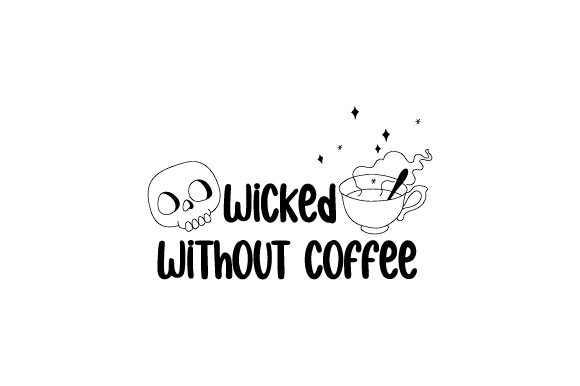
Wicked Without Coffee
First Impressions: Bold, Playful, and Instantly Recognizable
When I opened Wicked Without Coffee for the first time, I didn’t just see a skull and a coffee cup—I saw personality. It’s got that sly, slightly mischievous Halloween energy without tipping into spooky overload. The layout feels intentional: the skull anchors the top, the steaming mug sits just below like a punchline, and the phrase “Wicked Without Coffee” wraps around them with confident spacing. It’s not overly dense, but it’s not minimalist either—there’s enough visual weight to hold up on apparel and home goods, yet it avoids the clutter that can bog down embroidery execution.
A Real-World Test: Embroidering It on a Linen Tote Bag
Last week, I used Wicked Without Coffee on a natural linen tote for a local boutique’s holiday pop-up. Linen’s texture is unforgiving—loose weaves love to swallow satin stitch edges or let fill stitches shift. So before hooping, I ran through my checklist: stabilizer (medium-weight cutaway), thread contrast (deep espresso brown on off-white linen), and hoop size (5x7 was perfect—no stretching, no distortion). The result? Crisp lettering, clean skull contours, and a mug steam line that actually read as *steam*, not a stray running stitch. Customers paused, smiled, and asked where they could buy one. That’s the sign of a design that translates—not just from screen to fabric, but from craft to connection.
Where It Shines (and Where It Needs Care)
Wicked Without Coffee works beautifully on mid-weight fabrics where structure supports detail: sweatshirt embroidery, embroidered patch backings, aprons, pillow covers, and tea towels. Its balanced proportions mean it scales well—from a 3-inch chest placement on a baby onesie (yes, I tested it) to a bold 6-inch front panel on a unisex crewneck. As a machine embroidery design, it leans into satin and fill stitch confidently, but avoid pushing it onto ultra-thin tees or stretchy performance knits without testing first. On dark fabric, double-check how the white or light-thread highlights hold up—some versions may need an underlay tweak for full coverage.
Curved surfaces like caps? Proceed with caution. The skull’s top curve and the mug’s handle sit close to the edge of ideal cap-embroidery real estate. If you’re using Wicked Without Coffee for commercial embroidery on headwear, consider simplifying the outermost details—or repositioning it lower on the front panel. Same goes for tiny hoop sizes: below 4x4, the lettering tightens and loses readability. Always inspect small corners in your embroidery software before stitching—especially where the skull’s jaw meets the phrase.
Design Integrity Meets Customer Trust
What makes Wicked Without Coffee more than just a fun quote? It reads as handmade—not generic, not clip-art. That matters when you’re selling personalized gifts or building a small shop product line. Buyers notice when letterforms have rhythm, when negative space breathes, and when a skull doesn’t look like it wandered in from a stock vector pack. This design has subtle asymmetry and organic flow—qualities that elevate a finished product from “cute” to “curated.” For Etsy sellers and craft fair vendors, that distinction builds repeat customers and word-of-mouth referrals.
It also plays well across seasons. While its roots are in Halloween, the coffee theme gives it year-round legs—think “morning ritual” merch for baristas, teachers, or remote workers. I’ve seen it work on nursery decor (softened with muted thread palettes) and even wedding favors (“Wicked Without Coffee… or Champagne”). That versatility strengthens brand consistency if you’re developing a cohesive line of design assets.
Practical Designer Notes You Can’t Skip
- Test on scrap fabric first—especially with textured or dark materials. Linen, terry cloth, and fleece all behave differently with the same file.
- Check thread color contrast before stitching. A warm gray might vanish on heather charcoal; a bright white pops—but only if your stabilizer doesn’t shadow it.
- Review stitch density. High-density fill areas (like the skull’s eye sockets) can pucker thin fabrics. Consider reducing density by 5–10% if needed.
- Confirm hoop size compatibility—don’t assume it fits your standard 4x4 unless verified. Some versions may require 5x7 or larger for optimal clarity.
- Inspect small details at 200% zoom: Are the steam lines distinct? Does the mug handle separate cleanly from the body? These define professionalism.
- Test black-and-white mockups to gauge contrast and legibility before committing to color schemes.
- Use proper stabilizer—cutaway for knits, tear-away for stable wovens, and fusible + cutaway for lightweight linens.
- Verify licensing before selling finished items or digital embroidery files. Just because it’s labeled “for crafts” doesn’t automatically grant commercial rights—check the terms.
Final Thought: It’s Not Just a Design—It’s a Conversation Starter
I keep coming back to how Wicked Without Coffee performs in real life—not in isolation, but as part of a handmade product ecosystem. It invites interaction: people point, they laugh, they say, “That’s me.” That emotional resonance is rare in machine embroidery design. Whether you’re an embroidery designer sourcing reliable assets, a small business owner curating boutique merchandise, or a hobbyist stitching gifts for friends who truly get your humor—it delivers. It’s playful without being juvenile, thematic without being seasonal prison, and detailed without being fussy. In short: it stitches well, sells well, and feels like yours—even when it’s not.